RESEARCH ARTICLE | DOI: https://doi.org/dx.doi.org/JPHCI/PP.0010
1 Saranya V. N Department of Pediatrics, Mahatma Gandhi Medical College and Research Institute, Sri Balaji Vidyapeeth Pondicherry, India.
2 Karthikeyan Kadirvel, Professor. Department of Pediatrics, Mahatma Gandhi Medical College and Research Institute, Sri Balaji Vidyapeeth Pondicherry, India.
*Corresponding Author: Saranya V. N
Citation: Saranya V. N (2026) Counseling-Based Approaches To Improve Breastfeeding Practices: A Literature Revie, J. Pediatric Health and Clinical Insights 2(3): dx.doi.org/JPHCI/PP.0010
Copyright  :
© 2026 Saranya V. N. This is an open-access article distributed under the terms of the Creative Commons Attribution License, which permits unrestricted use, distribution, and reproduction in any medium, provided the original author and source are credited
:
© 2026 Saranya V. N. This is an open-access article distributed under the terms of the Creative Commons Attribution License, which permits unrestricted use, distribution, and reproduction in any medium, provided the original author and source are credited
Received: 23 February 2026 | Accepted: 01 June 2026 | Published: 20 June 2026
Keywords: structured breastfeeding counseling, exclusive breastfeeding, low birth weight infants, lactation counseling, breastfeeding support
Background: Breastfeeding is the optimal source of nutrition for infants and is especially vital for low-birthweight (LBW) neonates, who face increased risks of feeding difficulties, infections, and poor postnatal growth. Exclusive breastfeeding (EBF) rates among LBW infants remain suboptimal due to inadequate maternal knowledge, improper techniques, anxiety, and limited professional support. Evidence acquisition: A comprehensive review of literature published between 2015 and 2025 was conducted using PubMed, Scopus, Web of Science, CINAHL, and Google Scholar. Twenty studies evaluating structured breastfeeding counseling interventions were included. Results: Evidence consistently showed that structured counseling improves maternal knowledge, breastfeeding technique, confidence, early initiation, and duration of EBF. Interventions delivered through individualized counseling, digital platforms, and peer support were effective and scalable, particularly in resource-limited settings. Several studies also reported improvements in infant feeding behaviour and postnatal growth among LBW infants. Conclusion: Structured breastfeeding counseling is a low-cost, adaptable, and evidence-based strategy that should be integrated into routine maternal and neonatal healthcare services to improve breastfeeding outcomes.
Breastfeeding is universally regarded as the cornerstone of infant nutrition and early-life immunity. Human breast milk contains a complex matrix of essential nutrients, immunoglobulins, growth factors, and bioactive components that collectively support optimal immune development, gastrointestinal maturation, and neurodevelopment1 2. Exclusive breastfeeding for the first six months of life is associated with reduced neonatal morbidity, enhanced cognitive development, lower risk of chronic diseases, and improved long-term health outcomes3
For low-birthweight (LBW) infants—defined as those weighing between more than 1500 grams and less than 2500 grams—the benefits of breastfeeding are even more pronounced3. These infants are particularly vulnerable to feeding intolerance, hypoglycaemia, poor thermoregulation, infections, and inadequate postnatal weight gain 4,5. Consequently, ensuring effective breastfeeding practices is essential for improving survival and growth among this high-risk group4.
Despite strong global recommendations from the World Health Organization (WHO) and UNICEF, breastfeeding rates remain suboptimal, particularly among mothers of LBW infants3,6. Studies indicate that mothers frequently encounter challenges such as delayed lactogenesis, difficulty with latch and positioning, maternal anxiety, early introduction of supplementary feeds, cultural misconceptions, and inadequate professional support7–9. In many healthcare settings, breastfeeding counseling is often informal, inconsistent, and limited to generalized advice rather than individualized, skill-based support1,10.
Structured breastfeeding counseling is a targeted, evidence-based approach designed to address these gaps. It involves standardized, repeated, and individualized instruction on correct latch techniques, positioning, recognition of feeding cues, appropriate frequency and duration of feeds, breast milk expression, and troubleshooting common breastfeeding problems7,11,12. Structured counseling has the dual advantage of improving technical breastfeeding skills while simultaneously enhancing maternal confidence, motivation, and self-efficacy12–14.
This review synthesizes findings from twenty-one national and international studies to evaluate the effectiveness of structured breastfeeding counseling models and their impact on maternal and neonatal outcomes.
EVIDENCE ACQUISITION
A systematic search was conducted using PubMed, Scopus, Web of Science, CINAHL, and Google Scholar. Keywords included “structured breastfeeding counseling,” “exclusive breastfeeding,” “low birth weight infants,” “lactation counseling,” and “breastfeeding support.” Studies published between 2015 and 2025 were included evaluated structured counseling interventions and reported outcomes related to breastfeeding behaviour, EBF duration, maternal self-efficacy, infant feeding behaviour, or infant growth. Twenty-one additional studies were selected for synthesis. The search identified approximately 450–900 records. After removal of duplicates, 350–700 articles remained. Title and abstract screening reduced this to 40–90 studies, and full-text assessment ultimately identified about 21 studies that met all inclusion criteria for final analysis. (Explained in Consort flow diagram 1)
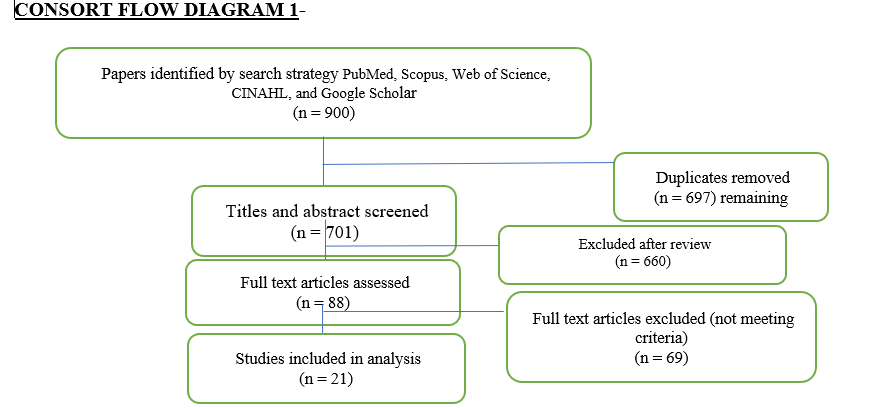
Inclusion and Exclusion Criteria for Evidence Selection
A structured and systematic approach was used to identify relevant studies for this review. Comprehensive research was conducted in five major databases for literature published between 2015 and 2025. Only full-text English-language articles were included. Studies were eligible if they evaluated structured or standardized breastfeeding counseling delivered through models such as bedside teaching, prenatal education, digital platforms, video-assisted counseling, peer support, or community-based programs. Eligible studies were required to report measurable outcomes related to breastfeeding practices, exclusive breastfeeding rates, maternal self-efficacy, infant feeding behavior, or neonatal growth. Randomized trials, quasi-experimental, observational, and mixed-method studies were included, while non-research articles and studies without structured counseling were excluded.
LITERATURE REVIEW
Effectiveness of Structured Skill-Based Breastfeeding Counseling
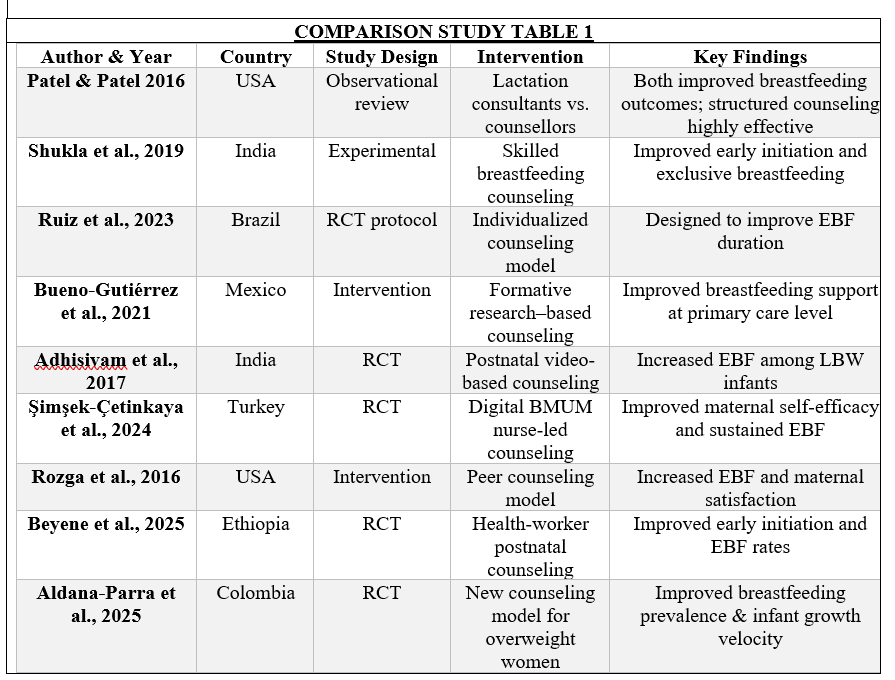
Several studies have demonstrated the effectiveness of structured, skill-based breastfeeding counseling in improving exclusive breastfeeding outcomes. Shukla et al. demonstrated that skilled counseling significantly increased exclusive breastfeeding rates in urban Indian populations15. Patel and Patel emphasized that structured counseling delivered by trained lactation consultants and counselors leads to improved breastfeeding outcomes1. Ruiz et al. proposed an individualized counseling model in their randomized controlled trial protocol, which closely aligns with the structured approach adopted in the present study11.
Ahmadi et al. applied the BASNEF behavioural model and demonstrated that structured counseling improved maternal attitudes and behavioural determinants related to breastfeeding. Although primarily focused on behaviour change, this study reinforced the importance of systematic counseling interventions for sustaining exclusive breastfeeding16.
Impact of Digital and Audiovisual Tools in Breastfeeding Counseling
Technological innovations have expanded the scope of structured counseling delivery. Adhisivam et al. evaluated video-assisted counseling among mothers of preterm LBW infants and reported significant improvements in exclusive breastfeeding rates7. Similarly, Şimşek-Çetinkaya et al. demonstrated that a nurse-led digital counseling platform (BMUM) improved maternal self-efficacy and breastfeeding continuation12.
Billah et al. found that electronic job-aid–assisted counseling in rural Bangladesh resulted in a significant increase in exclusive breastfeeding rates¹⁷. These findings support the scalability of digital counseling methods and complement the present RCT, which incorporated audiovisual aids along with hands-on demonstration and reinforcement.
Effectiveness of Peer Counseling and Community-Based Breastfeeding Programs
Peer and community-based models have also been shown to enhance breastfeeding outcomes. Rozga et al. demonstrated that integrated peer counseling significantly improved exclusive breastfeeding rates and maternal satisfaction13. Gupta et al. reported improvements in early initiation and continuation of breastfeeding through structured community-level counseling. Bueno-Gutiérrez et al. highlighted the success of community-informed counseling interventions at the primary healthcare level in Mexico15.
Effectiveness of Breastfeeding Counseling in High-Risk Maternal and Neonatal Groups
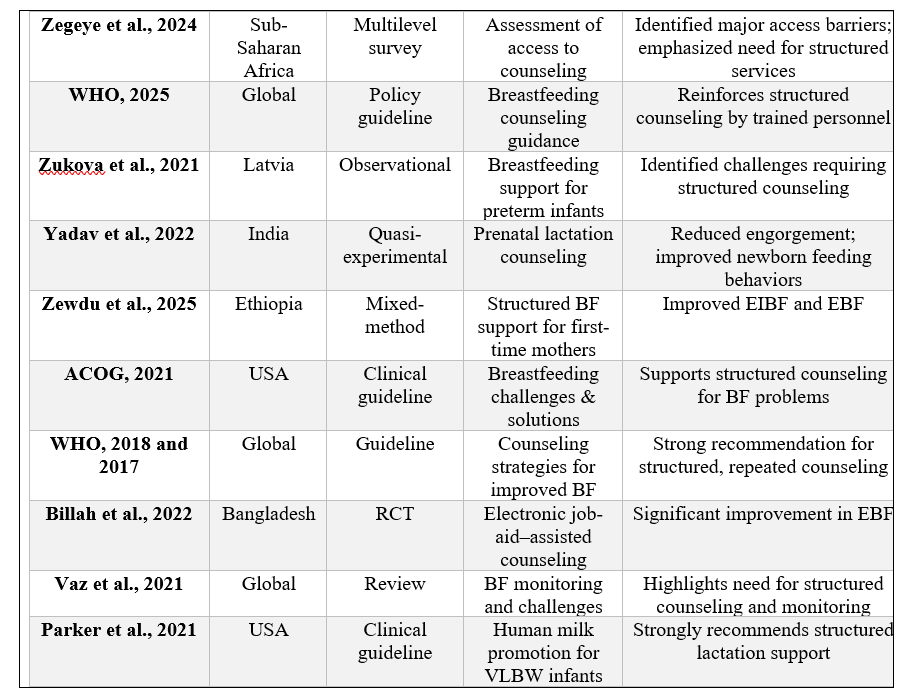
Structured counseling is particularly valuable for vulnerable groups. Zukova et al. highlighted the unique breastfeeding challenges faced by mothers of preterm infants and emphasized the need for specialized counseling support17. Aldana-Parra et al. demonstrated that structured counseling improved breastfeeding prevalence and infant growth velocity among overweight mothers18. Parker et al. strongly recommended structured lactation support as standard practice for very low birth weight infants4.
Systems-Level and Policy-Based Strategies in Breastfeeding Counseling
Global health organizations consistently emphasize structured breastfeeding counseling as an essential component of maternal and newborn care. WHO guidelines (2018, 2025) strongly recommend professional, repeated, and individualized breastfeeding counseling to improve breastfeeding practices6. The American College of Obstetricians and Gynecologists (ACOG) similarly advocates structured counseling for managing breastfeeding challenges10. Vaz et al. highlighted global gaps in breastfeeding monitoring and stressed the need for standardized counseling services19. Zegeye et al. identified significant barriers to accessing counseling services in Sub-Saharan Africa, reinforcing the importance of systemwide strengthening of lactation support20.
Effectiveness of Counseling in Promoting Early Initiation and Positive Breastfeeding Behaviour
Early counseling interventions have been shown to positively influence breastfeeding behaviour. Yadav et al. demonstrated that prenatal lactation counseling reduced breast engorgement and improved newborn feeding behavior8. Zewdu et al. and Beyene et al reported that structured counseling significantly improved early initiation of breastfeeding and exclusive breastfeeding rates among first-time mothers9,21.
Summary of Evidence
Collectively, these twenty-one studies consistently affirm that structured breastfeeding counseling—whether delivered through bedside instruction, digital platforms, peer support, or community programs—significantly improves maternal breastfeeding practices and infant feeding outcomes¹–¹⁹. (TABLE 1
Structured breastfeeding counseling is an effective, evidence-based strategy for improving breastfeeding outcomes, particularly in low-birth-weight infants. Consistent evidence shows that counseling enhances maternal confidence, breastfeeding technique, exclusive breastfeeding rates, and infant feeding behavior¹–¹⁹. It is feasible across multiple settings, including hospitals, community programs, and digital platforms7,13,18,21 12, and benefits high-risk and first-time mothers9,17,20. Global guidelines strongly recommend integrating structured counseling into routine maternal and newborn care3,6,10. Strengthening health-worker training and incorporating multimodal support can further optimize breastfeeding practices. As a scalable and low-cost intervention, structured counseling offers significant potential to improve infant nutrition, growth, and long-term health.