REVIEW ARTICLE | DOI: https://doi.org/dx.doi.org/NID/PP.0006
1 Northwestern A & F University, Yangling, China
2 Institute of Soil and Water Conservation, CAS & MWR, Yangling, China
*Corresponding Author: Guo Zhongsheng Northwestern A & F University, Yangling, China
Citation: Guo Zhongsheng (2026). High-Quality Agricultural Products and Public Health, J Nutrition and Human Health Advances 2(2): dx.doi.org/NID/PP.0006.
Copyright  :
© 2026 Guo Zhongsheng. This is an open-access article distributed under the terms of the Creative Commons Attribution License, which permits unrestricted use, distribution, and reproduction in any medium, provided the original auth or and source are credited.
:
© 2026 Guo Zhongsheng. This is an open-access article distributed under the terms of the Creative Commons Attribution License, which permits unrestricted use, distribution, and reproduction in any medium, provided the original auth or and source are credited.
Received: 19 September 2025 | Accepted: 11 March 2026 | Published: 16 April 2026
Keywords: agriculture high quality development, resources use limit by plants, vegetation carrying capacity, critical period of plant resources relationship regulation, quality, healthy, yield and benefits, sustainable utilization of natural resources
Agricultural development has entered a new stage of high-quality growth. High-quality agricultural development refers to the adoption of certainmeasures and methodsto enable the land to generate the maximum outputand services, and to meet people's aspirations for a better life and agricultural production services. The theoretical basis for high-quality agricultural development lies inthe utilization limitof plant resources, the carrying capacityof vegetation, and the criticalperiod for regulating the relationship between plant resources. This includes the utilization limit of plant spatial resources, the carrying capacity of spatial vegetation, and the critical period for regulating the relationship between plant spatial resources in areas rich in soil moisture and soil nutrients. The critical period for regulating the limit of plant soil water resource utilization, the carrying capacity of soil moisture and vegetation, and the relationship betweenplants and water in water-restricted areas. The approachto high-quality agricultural development lies in selecting the best seeds or varieties, determining the appropriate initial planting density, regulating the relationship between plant resources, ensuring good plant growth, achieving the quality, maximum yield and benefits to realize the sustainable utilization of natural resources and high-quality agricultural development.
Agriculture development is the foundation of high- quality development. Agricultural development has gone through a long process. According to the efficiency of resources plants use, Agricultural development can be dividedinto three stages,original agriculture stage, yield and quality increasing stage and Agriculture high quality development.
In the first stage of agricultural development, that is, the primitive agricultural stage, the population is small, living by pickingwild fruits, and the utilization rate of resources is low.
The second stage of agricultural development is the stage of increasingproduction and quality. The turning point from the primitive agricultural stage to the stage of increasing production and quality is the domestication of wild plantsand the breedingof high- yield and high-quality ones. During the stage of increasing yield and quality, as the production and services of native vegetation could not meet people's needs, most of the old forests turned into non-native vegetation, such as forests, grasslands, fruits and crops. At this stage, people cultivate and use better plant varieties or species, apply chemical fertilizers and pesticides, irrigate, etc., to increase the yield and quality of plants. Due to the existence of a large number of superior plant species or varieties in the production and cultivation of artificial vegetation, there are unscientific phenomena such as excessive application of chemical fertilizers and abuse of pesticides. This can easily lead to overloading, causing soil degradation, vegetation rot, and poor harvest or underloading of crops,resulting in resourcewaste and environmental pollution, and affecting the quality and quantity of agricultural production and services. It is impossible to achieve the maximum output and benefits to meet people's aspirations for a better life and agricultural products. Therefore, agricultural development has entered a new stage of high-quality production (Guo 2022, 2025). Since 2017, China's development has shifted from high-speed growth to high-quality growth, and agricultural development has also entered a new stage (Guo 2024). High-quality agricultural development refers to the adoption of certain measures and methods to enable the land to generate the maximum output and services, so as to meet people'saspirations for a better life and the needs of agricultural production services (Guo 2022, 2024, 2025).
However, because land use change, application of fertilizer and pesticide alters the plant resources relationship, easily resulting in soil and vegetation degradation and crop failure because of overload, or resources waste because of low load, both are unfavorable for the sustainable utilization of nature resources and crops high-quality production. Therefore, it is necessary to select excellentspecies or varieties according to the site condition and the market need, adopt appropriate initial planting density, and take effective measures, such as weeding, fertilizing and watering and so on to regulating the relationships between plant growth and resources supply and consume in the process of crop production to obtain the maximum yield and benefits and realize the sustainable utilization of naturalresources and achieve high quality agricultural production.
The theoretical foundations of Agriculture high quality development include resources use limit by plants, vegetation carrying capacity and the critical period of plant resources relationship regulation, which include space resources use limit by plants, space vegetation carrying capacity and the critical period of plant space relationship regulation in soil water and nutrient rich regions; soil water resources use limit by plants, soil water vegetation carrying capacity and the critical period of plant water relationship regulation in water-limited regions and soil nutrientresources use limit by plants,soil nutrient vegetation carrying capacity and the critical period of plant nutrient relationship regulation. In this paper, take the semiaridregion as an example to introduce the theoretical foundations of Agriculture high quality development (Guo 2022,2024,2025). The details are as following:
The nature resources ae limit on the earth, so, the use of what plant use nature resources is limit , the limit is resources use limit by plants, which includes the spaces resources use limit by plants and spaces vegetation carrying capacity and critical period of plant space relationship regulation in soil water and soil nutrient enough regions; soil nutrient resources use limit by plants and soil nutrient vegetation carrying capacity critical period of plant nutrient
resources relationship regulation in nutrient limited regions and the soil water resources use limit by plants (SWRULP) and soil water vegetation carrying capacity (SWVCC) and the critical period of plant resources relationship regulation in water limited regions. The critical period of plant resources relationship regulation is the critical period of plant water relationship regulation in water limited regions Because the main factors affecting plant growth are different in different regions.
Nature resources is the foundation of Agriculture high-quality development. Nature resources is
the Soil waterresources in water-limited regions.
Soil water resourcesproposed by Budagovski in 1985 (Budagovski 1985), is a good
resources. The resources use limit by plants is the soil water resources in the maximum infiltration
depth (MID) when the soil water contentin every soil layer equal to wiltingcoefficient, which changeswith vegetation type and site condition. For example, the precipitation changesand the infiltration depth change with time in the Red Plum Apricot Orchard in semi- arid loess hilly region(Guyuan, China). The soil water suction change with soil water contentat the same soil depth (Guo 2010, 2022).
Briggs and Shantz (1912) emphasized the importance of the wilting coefficient. Richards and
Weaver (1943) observed that soil water potential at wilting ranged from -0.1×10⁶ to -0.2×10⁶
MPa, with an average of approximately -0.15×10⁶ MPa (15 bar). Therefore, the water content at - 0.15×10⁶ MPa is the pointat which soil moisture
usually becomeslimited severely (Kramer,
1983, Parchami-Araghi et al., 2013). The wilting
coefficient is equalto the soil water contentwhen soil water suction is equal to 15 Ba because the wilting coefficient changed with plant species with a range from 10 Ba to 20 Ba, whichchange with soil depth and expressed by the wilting coefficient of indicate plant in a plant community.
Vegetation carrying capacity (VCC) is the ability of land resources to support vegetation, which was expressed by the population or density of indicator plants in a plant community and changes with vegetation type, time (climate change) and site condition (Guo et al, 2002; Guo & Shao 2003, 2004; Guo 2004, 2010, 2014,2022). Vegetation carrying capacity includes spaces vegetation carrying capacity in soil water and nutrientrich regions, Soil nutrientvegetation carrying capacityand soil water vegetation carrying capacity (SWVCC) (Guo and Shao, 2004, 2013; Guo 2004, 2014, 2019, 2021,2025).
The plant resourcesrelation change with plant growth since planting or sowing in a giving site condition. When the size of plant is small, the plant available resources in crown or root are smaller than the resources use limit by plants, the plant resources relation is good and plant grow well. If the plant available resources in crown or root is equal to the resources use limit by plants, the plant resources relation enters the critical period of plant soil relationship regulation. The ending time of the critical period of plant resources relationship regulation is the ineffective time of regulating plant resources relation. The critical period of plant resources relationship regulation includes critical period of plant space relationship regulation in soil water and soil nutrient enough regions, the critical period of plant nutrient resources relationship regulation in nutrient limited regions and the critical period of plant resources relationship regulation in water limited regions. For example, in water limited regions, the soil water resources are the most important resources influencing plant growth. the critical period of plant resources relationship regulation in water limited regions is the critical period of plant water relationship regulation in water limited regions in semiarid loess hilly region. The endingtime of red plum apricotis stop expanding on 15 July, So,the ending time of the critical period
of plant resources relationship regulation for the red plum apricot is the 15 July. The critical periodof plant resources relationship regulation for the caragana shrub in semiarid loess hilly region is the end of September because caragana shrub is soil and water conservation forest, which stop serving as conservating soil and water in the raining period.Because the main factors affecting plant growth are different in different regions. If the soil water resources in the MID in the critical period of plant soil relationship regulation soil water resources is lower than the SWRULP, the plant water relation enters the critical period of plant soilrelationship regulation (CPPSRR)(Guo 2019,2021). At this stage, we shouldcare about the plantresources relation.The end time of CPPSRR is the failure time of the regulation of plant-soil relationship. The critical period for regulating the relationship between red plum and apricot plants and soil ends in July 15 because at this time, red plum apricot stops expanding and for caragana is the end of September because caragana stops serving in the Loess hilly region. The relationship between plant density and soil water supply and soil water consumption in the critical period of plant soil relationship regulation in caragana shrubland of semi-arid loess hilly region (Guyuan, China), see fig.4.If present plant density is more than SWVCC in the critical periodof plant soil relationship regulation, plant waterrelationship has to be regulated based on SWVCC to get the maximum yield and service. For fruit trees or crops, the relationship between vegetative growth and reproductive growth should be reregulated according to the suitable leaf when the presentplant density in the criticalperiod of plant resource relationship regulation is equal to the vegetation carrying capacity, and the leaf and fine fruit relationship to obtainthe maximum yieldand benefits.
To carrying out Agriculture high quality development,we should take some effective measures and method. The basic methods of Agriculture high quality production as following:
First, we must select better species or varieties according to the site condition and market need because different fruittree produce different fruit, and better species or varieties influence the yield, quality and economic effect and market influence the marketing of production. For example, in semiarid loess hilly region, after a couple of yeas research, the red plum apricot has been selectedas the better species and promoted in large scale (Shi and Guo 1995), See Fig.1. According to the market investigation in the 29th China Yangling Agricultural High-tech Achievements Expo, the fine apple cultivated by Luochuan fruit farmers is the fine apple with the diameter equal to or more than 90 cm. It is a good apple but it is a little bigger, one cannot eat an apple one time, so it is little big more and one cannot eat an apple a time, 85 apple is good, according to the investigation in Sichuan, China, the standard of prickly ash is different in Taiwan, Macau and Hongkong. We should take effect
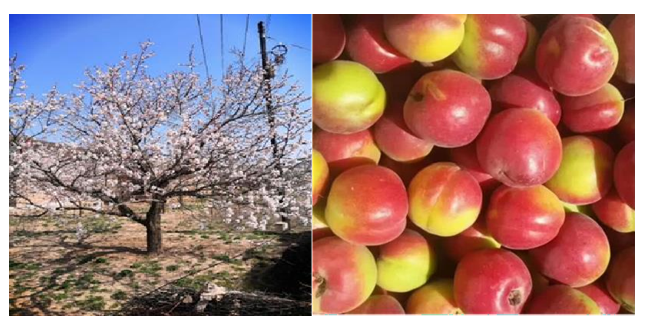
Figure 1. The flowerand fruit of red plum apricot in the semiaridloess hilly region(left photo is flower in May and Right photois fruit in July)
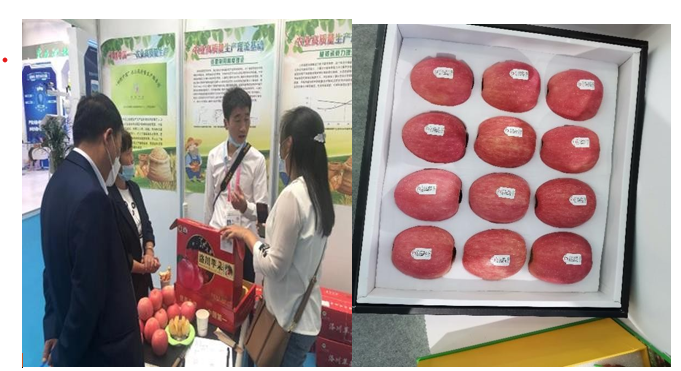
Figure 2. The 29th China YanglingAgricultural High-tech Achievements Expo Luochuan Apple Market Research(The left picture shows the Luochuan apple market research in May, and the right picture shows the high-quality apples grown by Luochuan fruit farmers.measure to produce different quality production and meet the need of different market, see fig.2 (Guo 2025).
3.2. Take Suitable InitialPlanting Density
Planting density influences the plant growth and yield and service. If the Initial planting density is smaller, which influence the yield and benefits, so we must take the suitable initial planting density.The suitable initialplanting density is equal or more than vegetation carrying capacity because it is easier to reduce the plant densityin the process of plant growthand use the natural resources in sustainable way. For example, in semiarid loess hilly region,the
suitable initial planting density of caragana is 6500 trees per 100 m2, and the sowing seed is 1.5 kg per 100 m2. As for one year plant, such as pepper, see Fig.1, we can estimate the suitable Initial planting density according to the crown area per one standard plant with big fruit. The standard plant is a good plant with a maximumcrown, yield and beneficial effect, see Fig.3 (Guo 2025).
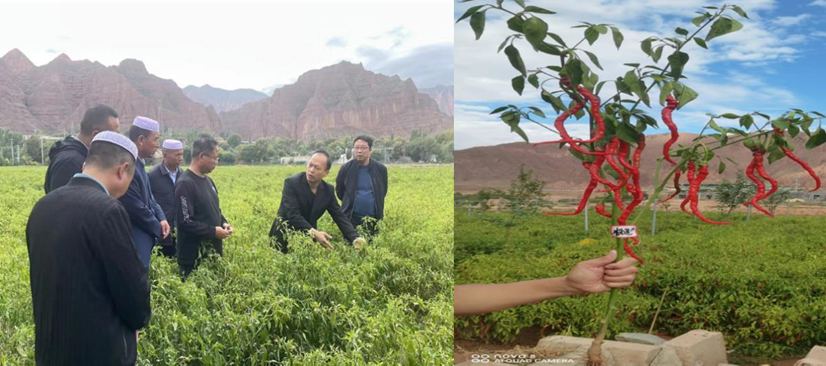
Figure 3. Taking the standard plants in Xunhua area, Qinghai Province, China in March 2023 as an example, the estimation method for the suitable initial planting density of peppers was introduced to the local people. The picture on the right shows a standard plant of chili peppers,which is 60 cm tall and has a canopyof 30cn×40cm, with the highestyield and servicequality.
3.3 Take Some Effective Measures To Make Plant Grow Well And Get The Cultivate Goal
We should take some effective measures, such as weeds, fertilizer and so on because the weeds, fertilizer and water affect plant growth. In order to make plant grow well and get the cultivate goal we can get the quality fruit and expected nutrient, we must take effective measures such as weeding, fertilization according to the appropriate amount of fertilizer, irrigation according to the water requirement of plants and promote plant growth to get maximum yield and benefit to carry out cultivated goal. If available resources in crown layer in water and nutrient rich regions or root zone in water-limited regions or nutrient limited regions decrease to the limit of resource utilization by plant, the plant water relation enters the critical period of plant resources relation regulation. If the plant density exceeds the vegetation carrying capacity in the critical period of plant resources relation regulation, the plant resources relation should be regulated according to vegetation carrying capacity in the critical period of plant resources relation regulation (Guo 2014,2 021). We should take effective measures, such as weeding, rational fertilizing and irrigation (if having water resources) to ensure plant growth well in the process of production and get the cultivated goal. The cultivated goal is the need of market for production. if theproduction does not meet the need, you cannot get the benefit. If the plant density is more than the vegetation carrying capacity in the critical period of plant resources relation regulation, showing that the plant resources relationship should be regulated, otherwise the further increase of natural resources used by plant will lead to the declineof vegetation and thedecline of grainyield and quality(Guo et al, 2002; Guo & Shao,2003, 2004, 2010, 2013; Guo 2014; 2021 and 2021, 2022, 2023, 2024, 2025).
Agriculture development has lasted a long time and now entered the stage of high-quality development, which is to take some measures and methodsto make the land producethe maximum output and services to meet people's yearning for a better life and the needs of agricultural production and services. High-quality development of agriculture is the foundation for high-quality economic and social development. The theoretical basis for high-quality agricultural development lies in the limit of plant resource utilization, the carrying capacityof vegetation, and the critical period for regulating the relationship between plants and resources. This includes the limit of plant spatial resource utilization, the carrying capacity of spatial vegetation, and the criticalperiod for regulating the relationship between plants and spatial resources, as well as the limit of plant-soil-water resource utilization and the critical period for regulating the carrying capacity of soil-water-vegetation and the relationship between plants and water. Moreover, the utilization of soil nutrient resources is restricted by plants, and soil nutrients are affected by the relationship between the carrying capacity of vegetation and the regulation of plant nutrientsduring critical periods. The approach to high-quality agricultural development is to select superior tree species or varieties, adopt appropriate initial planting densities and effective measures to ensure that plants grow well during the production process and achieve the cultivation goals. From now on, it is necessary to strengthen basic agricultural research, determine the critical periods for adjusting the utilization limits of plant resources, the carrying capacity of vegetation and the relationship between plant resources at different sites and for differentplant species, and then adopt methods for high-quality agricultural production to select the best plant species or varieties. Adopt appropriate initial planting density and effective measures to ensure good plant growth, achieve maximum yield and benefits, and realize the sustainable utilization of natural resources and high- quality agricultural development.
Because of the large agricultural area (Keiblinger et al., 2023) and the increasing population, which has exceeded8.2 billion at present,different regions have different crops speciesor varieties suitablefor growth, so it is necessary to establish demonstration site of agriculture high-quality development in different regions to strengthen the research on agricultural high- quality development to meet people's needsfor a better life and crop types, yieldsand quality. At present, I am leading the " innovation China", agricultural high- quality productionand industrial service group to
widely publicize and promote the new theories of the agriculture high-quality development, the theories of capacity theory and the critical period theory of plant resource relationship regulation and take effective methods or measures to carry out sustainable use of resources and agriculture high-quality development to serve food security, people’s healthy, rural revitalization and the construction of beautiful world.resource utilization limit, vegetation carrying
This project is supported by the National Science Foundation of China (No: 42077079, 41271539, 41071193).